
Adente Vision
Adente Vision is a plug-and-play AI inspection unit that catches defects, verifies assembly, reads barcodes, measures down to 0.01 mm, and identifies the part, all five checks in one industrial enclosure running on edge AI.
Built by the engineers who commission the systems it runs on. See what we build
Visit Adente VisionAI inspection connected directly to line control
Manual inspection is slow, inconsistent between operators, and impossible to scale to every part. Sampling means defects are found downstream, after more value has been added to the parts around them. Automated inspection that only produces a report does not solve this, because somebody still has to act on the result.
Adente Vision is a single integrated unit that performs five checks at once: anomaly detection, defect detection, assembly verification, precision measurement, and part identification. Because it is one system rather than a multi-vendor integration, it installs on the line without becoming a project of its own.
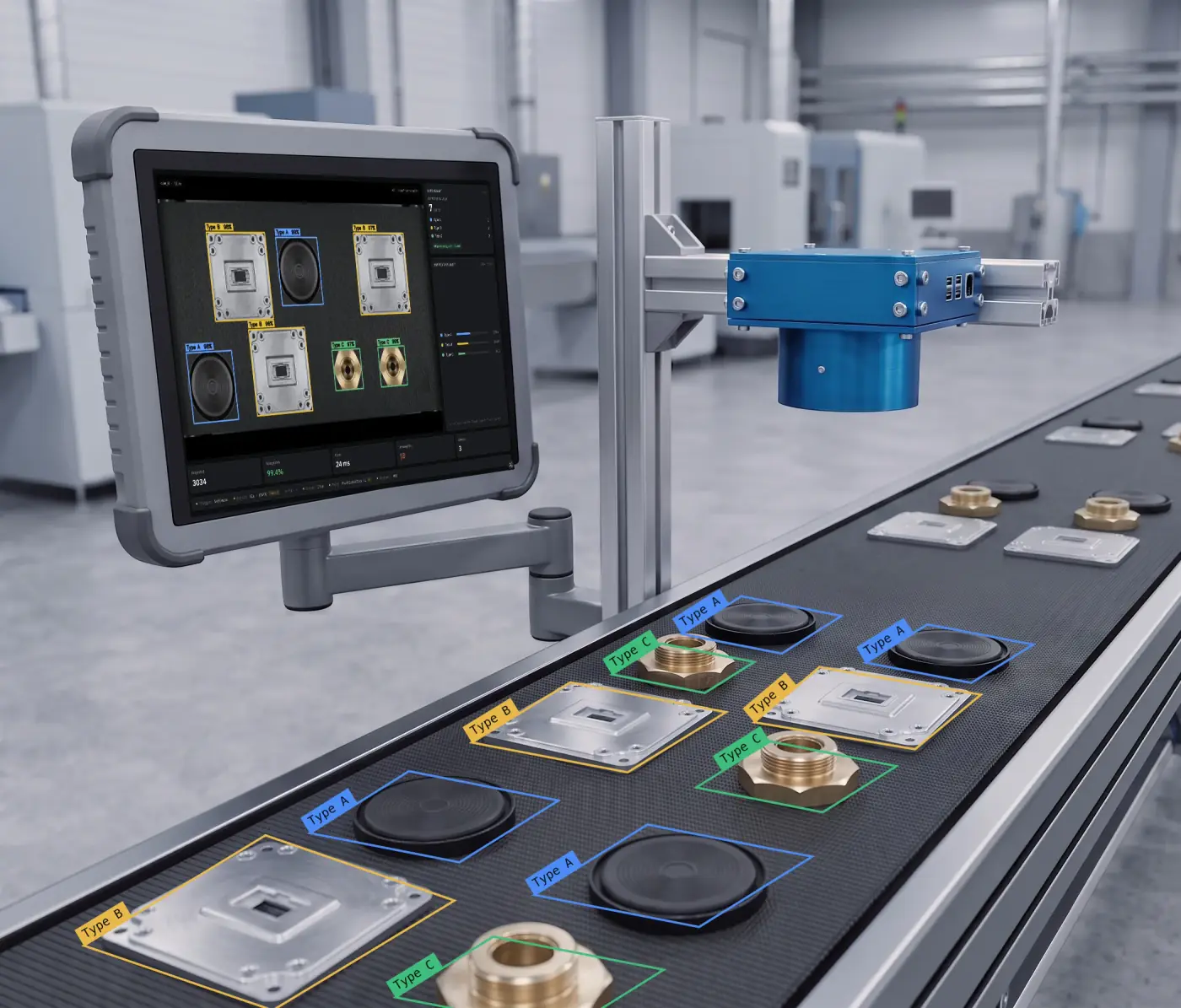
Inside Adente Vision
Anomaly detection
Flag out-of-spec conditions in real time, including defect modes no explicit rule was written for.
Defect detection
Identify surface and structural defects as parts move down the line, at line rate.
Assembly verification
Confirm that components are present, correct, and assembled in the right configuration.
Measurement and part ID
Perform precision dimensional measurement and part identification within the same unit.
How we deploy it
- ›Installs as a single unit rather than a multi-vendor vision integration
- ›Feeds results back to line control systems for automatic reject handling
- ›Commissioned by the same team that integrates the surrounding automation
- ›Models trained on parts from your own line, not generic reference data
Industries
- ›Automotive assembly lines
- ›Electronics manufacturing
- ›Precision manufacturing
- ›Pharmaceuticals & food
Frequently asked
What are the five inspection modes?
Anomaly and defect detection, assembly and missing-part verification, code reading (barcode, data-matrix, QR, printed text), dimensional measurement down to 0.01 mm, and part identification. All five run in one enclosure on edge AI hardware.
How long does it take to deploy on a line?
Hardware installs in about 30 minutes. Model training needs roughly 20 good parts from your line, and a ready model is typically running in under 48 hours.
What protocols does it support?
PROFINET, EtherNet/IP, Modbus TCP, EtherCAT, OPC UA, and digital I/O, so it connects to the line control systems already on your floor.
How many parts can it inspect per second?
The edge processor runs inference in roughly 30 ms per part, giving over 30 decisions per second at line rate.
Discuss a project with our engineers
Our engineering team is available to scope new projects, evaluate retrofits, and review system requirements.