Automotive
Automotive production sets the tightest constraints we work under: cycle times measured in seconds, strict finish quality, and no tolerance for a line stop.
Paint shop automation and assembly line inspection
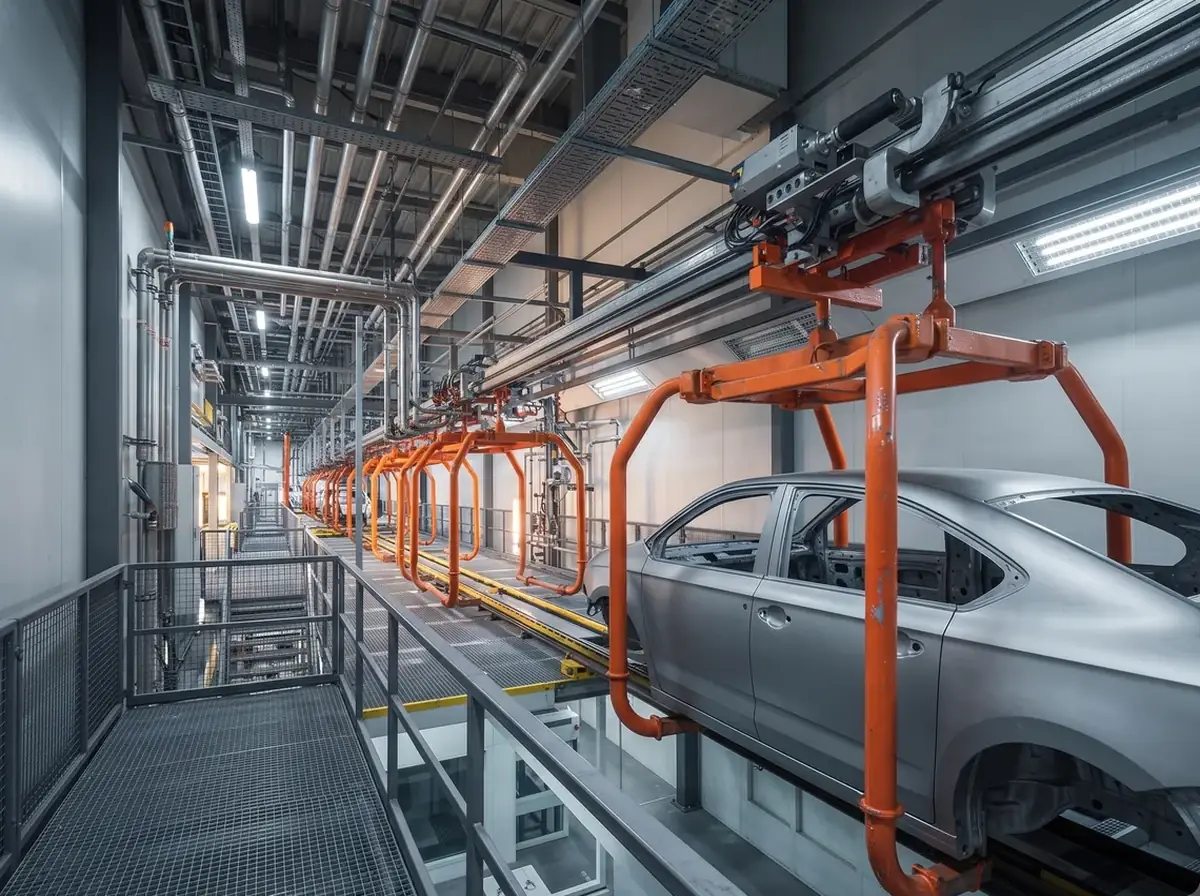
Our automotive work centres on the surface treatment chain, where cleaning, priming, painting, and sealing all have to happen within cycle time and to a finish quality the customer will inspect up close. That requires robot programming, multi-robot coordination, and vision that can judge a sealant bead while the body is still moving.
This is our longest-running line of work, built on two decades of paint shop and body shop commissioning across Turkish and German plants. That experience shapes our control tooling, which is built around the failure modes these lines really have.
Common challenges
Finish defects are found too late
Paint and sealant faults discovered at final inspection mean rework on a nearly complete vehicle, or a unit pulled from the line.
Cycle time governs everything
Any added inspection or process step has to fit inside the existing takt time or it costs throughput across the whole plant.
Multi-robot cells are hard to coordinate
Cells with several robots sharing a workspace need synchronisation and collision handling that survives real production variation.
Retrofits cannot stop production
Upgrades to a running line have to be staged around planned shutdowns, with commissioning that works first time.
What you gain
Finish defects caught in-line rather than at final inspection
Inspection that fits inside existing cycle time
Coordinated multi-robot cells with safety certification support
Retrofits commissioned inside planned shutdown windows
How we deliver it
The capabilities we use on automotive projects.
Products used here


Discuss a project with our engineers
Our engineering team is available to scope new projects, evaluate retrofits, and review system requirements.